Mastering Liquidity Aggregation
In a decentralized realm, when dealing with DeFi and liquidity, outcomes may not always align with initial expectations.
This article does not cover how Fibrous works as we have already delved into this topic extensively in our previous articles. Therefore, prior to commencing your reading of this article, if you are new to DeFi aggregators, we strongly recommend perusing our initial blog posts.
Without further ado, it should be emphasized that the primary objective of aggregators is to consolidate all liquidity resources on a blockchain (It doesn't have to be the only one, we'll get to that later) and facilitate the exchange of your funds with the most favorable prices available.
In simpler terms, aggregators serve as a means to swap your capital in the most efficient manner possible.
Nevertheless, it is essential to recognize that navigating this terrain is not as straightforward as it may appear. The best aggregator does not necessarily equate to the aggregator with the best prices. The intricacies of the dark forest of DeFi often lead to unexpected outcomes.
The Fibrous team staunchly embraces Starknet as a preferred solution. Our dedication to Starknet runs deep, and we aspired to be among the first applications on this groundbreaking universal validity rollup.
As a team, we possess an extensive (and truly substantial) background in DeFi, which provided us with valuable insights into the rapid emergence of numerous AMMs on Starknet.
Unlike Optimistic Rollups and other validity rollups that utilize zkEVM, Starknet offered an entirely fresh environment (yes, CairoVM our love), fostering a diverse ecosystem.
Nevertheless, we were well aware that each AMM that surfaced conducted swap operations solely within its own platform, creating a less than ideal user experience. Despite a single AMM boasting greater liquidity than its competitors, the unavoidable losses stemming from slippage and price impact in high-volume swap transactions remained a concern for users.
If you are curious about the origins of this slippage loss, we suggest referring to our earlier blog posts or this.
Notwithstanding our admiration for the vast diversity and vibrant ecosystem, we recognized that this multiplicity could lead to suboptimal user experiences. Consequently, we introduced the AMM Aggregator Fibrous, a platform that consolidates all these AMMs and liquidity sources in a unified interface, and we diligently embarked on its development.
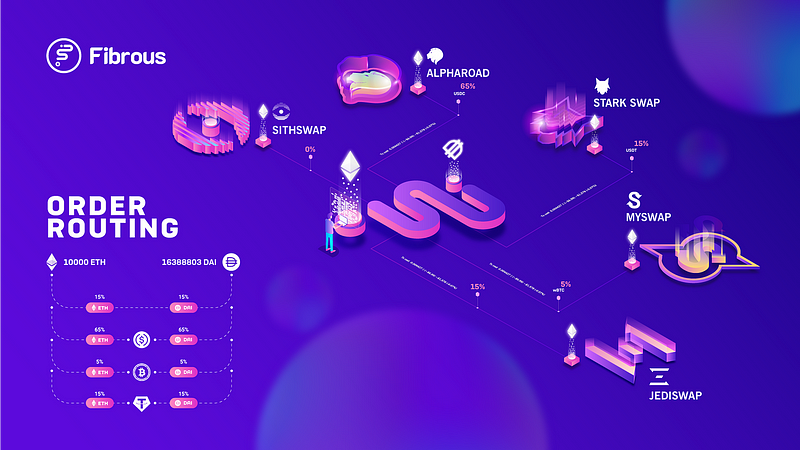
As a consequence, we proudly unveiled Fibrous as Starknet’s first pioneering aggregator. As of the current date, it has facilitated a trading volume of 11 million dollars. yay. 🎉
Having acquainted ourselves with the benefits of aggregators, let us now delve into the intricacies and discuss the key attributes of an effective aggregator.
The aggregator offering the best price may not necessarily always be the most optimal choice.
Indeed, merely offering the best price does not automatically confer the title of the finest aggregator.
The primary objective of aggregators is, indeed, to secure the most favorable price. However, in the pursuit of delivering the best price, aggregators should also take into account the transaction costs associated with executing such operations.
To illustrate this point, consider a scenario where the price of 1 Ether stands at $2000. Suppose aggregator A quotes $1999, and aggregator B quotes $1998. If the transaction fee for aggregator A amounts to $5, while aggregator B’s transaction fee is only $1, then aggregator B becomes the more preferable option despite not offering the absolute best price.
The gas expenditure varies among each AMM, including the pools within these AMMs, and even for each token, thereby resulting in distinct transaction fees.
For instance, it is surprisingly more cost-effective to send the same amount of DAI to your friend on the Ethereum Mainnet than sending an equivalent amount of USDT. This divergence stems from how the contract is written; the more intricate a contract, the higher the transaction fees it incurs. For instance, conducting a swap in Uniswap v2 is cheaper than performing the same action in v3.
Consequently, each AMM, pool, and token employs a different transaction fee calculation methodology.
An effective aggregator should prioritize providing the best price amortized after accounting for transaction fees, rather than simply presenting the best price at face value.
It is essential to bear in mind that the transaction fees increase proportionally with the number of routes and splits an aggregator employs for the swap. Thus, a careful balance must be struck between the number of routes taken and optimizing transaction fees.
So, how about Fibrous then?
Fibrous operates with an algorithm designed to identify the most advantageous route by meticulously calculating all transaction fees involved. Should the gas fee not justify taking new routes during a swap transfer, Fibrous refrains from determining an alternative route.

Furthermore, it is noteworthy to mention that Starknet offers more cost-effective transaction fees for aggregators compared to other rollup solutions. The reason lies in Starknet’s utilization of state diffs for data availability rather than CALLDATA. Consequently, Starknet solely publishes the block outcomes to the Ethereum network, thereby rendering aggregators like Fibrous and oracle services such as Pragma more economical for users.
A proficient aggregator also serves as the most efficient guardian of your funds.
Indeed, a subpar aggregator has the potential to result in the complete loss of your funds.
As mentioned earlier, we referred to it as a “Dark Forest.” An inadequate aggregator can genuinely lead to the depletion of all your assets.
To grasp this concept, allow us to illustrate, in a succinct manner, what transpires with your transfer when you initiate the swap action.
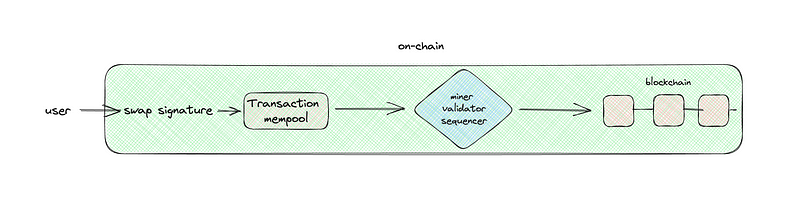
When conducting transactions on blockchains, these transactions initially wait to be included in the blockchain in an area known as the “Mempool.” Miners or validators on the blockchain (currently only one Sequencer for Starknet) then record these pending transactions onto the blockchain.
Every transaction made on Starknet follows these stages.
Now, let’s consider a scenario:
Suppose a whale intends to increase the price of Ether and swaps 10 million USDC for Ether. In such a case, the price of Ether will rise. However, as soon as the whale performs the swap, it enters the mempool. Now, what would happen if another individual, observing this transaction, anticipates an increase in Ether’s price and wishes to buy Ether as well? What if the current validator writes this person’s transaction onto the blockchain before processing the whale’s transaction?
This process, which interferes with the whale’s intended transaction, is referred to as “Front-running.” It serves as an example of a Miner Extractable Value (MEV).
So;
MEV stands for Miner Extractable Value, which quantifies the potential profit that a miner (or validator, sequencer, etc.) can gain by leveraging their capacity to selectively include, exclude, or reorder transactions within the blocks they generate.
So, what relevance does this phenomenon known as MEV have to Fibrous and Aggregation?
Currently, any transaction you initiate on DeFi applications within Starknet, including Fibrous, remains in the mempool, awaiting processing by the Sequencer to be included in blocks.
Consequently, all transactions carried out in Fibrous are susceptible to external observation and potential MEV exploitation, which may lead to receiving fewer tokens than intended. To mitigate this concern, Fibrous and other Automated Market Makers (AMMs) implement a mechanism called “Slippage Tolerance.” For instance, setting the Slippage Tolerance to 1% ensures that the amount swapped cannot fall below 1%.
Let’s illustrate with a simple example: If you expect to receive 10,000 USDC in a swap with a 50% slippage tolerance, you may end up with 5,000 USDC. By increasing the slippage tolerance, the likelihood of encountering MEV in Ethereum swaps significantly rises.
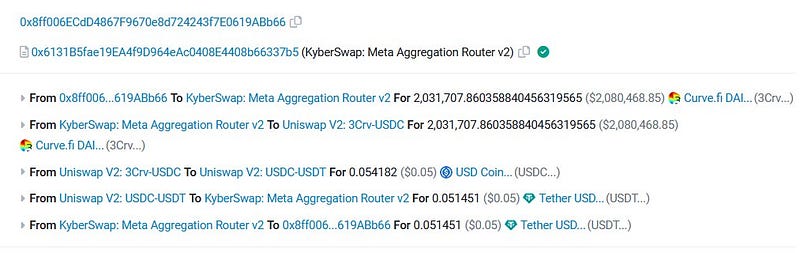
It should be noted that the transfers most susceptible to MEV are those originating from aggregators.
However, the situation is somewhat different in Starknet. Thanks to Starknet’s singular Sequencer, MEV is not present as the sequencer does not engage in such activities.
However, this scenario could undergo a transformation.
As Starknet moves towards decentralization, a consensus mechanism will be established, and validators, similar to those in Ethereum, will be responsible for incorporating these transfers into the blocks. Consequently, this will introduce the potential for encountering MEV, and it raises the question of what measures can be taken to mitigate this situation beyond adjusting the Slippage Tolerance.
In such a decentralized setup, how can MEV be addressed effectively? Are there other strategies or protocols that can be implemented to safeguard against its negative impact?
As of now, our reliance on Starknet’s Sequencer has led us to adopt the approach of adjusting the slippage tolerance for Fibrous, and no further action has been taken in this regard. However, we anticipate changes in the future, and as part of our ongoing development, we plan to introduce a “Swap Matching Engine.” This innovative engine is designed to offer comprehensive protection against MEV and yield significantly improved outcomes. Moreover, it will pave the way for entirely gas-free transactions, enhancing the overall user experience on our platform.
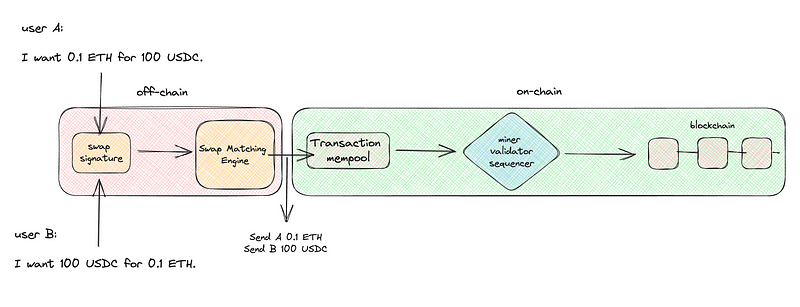
As demonstrated above, we are introducing the “Matching Swap Engine,” a mechanism that enables the seamless matching of buyers and sellers through an off-chain signature process with the Relayer. This innovative approach ensures that the transaction takes place on-chain not as a simple swap transfer but as a mutual token transfer.
By adopting this system, we can effectively eliminate the risk of MEV, thereby reducing on-chain transaction costs and facilitating a more economical and efficient process. Additionally, with the possibility of increasing the number of Relayers, we can achieve the best price through a meta-aggregation, wherein the most favorable prices are aggregated among multiple Relayers.
This system is founded on the economic principle known as CoW (Coincidence of Wants), wherein two parties possess items that the other desires, allowing for a direct exchange without the requirement of any intermediary monetary medium. Also see
The positive aspect is that we have diligently prepared Fibrous for these updates right from DAY ONE and incorporated them into our roadmap. Even when there was only one AMM on Starknet, we formulated our plans accordingly.

A superior aggregator surpasses its boundaries and limitations.
Not finished yet.
A commendable aggregator goes beyond merely aggregating liquidity within one blockchain; it extends its reach to include all other blockchains. Indeed, such a feat is achievable.
Consider this scenario: Imagine bringing a portion of the most optimized USDC equivalent to 1 Ether on Starknet from an AMM operating on Polygon zkEVM.
This can be achieved, and we are determined to make it happen. Thanks to Herodotus’s Storage proofs, a technology enabling cross-domain data access between Ethereum layers, Fibrous can access liquidity information from other validity rollups and facilitate the transfer of liquidity between blockchains in a trust less manner.
As devoted Starknet Maximalists and a team that holds steadfast belief in Ethereum’s principles, we aim to integrate liquidity from all Rollups into Fibrous within a modular future where Rollups can exchange value in a highly cost-effective and secure manner.
In summary, the success and performance of liquidity aggregation, as well as the aggregators, are influenced by factors like MEV, price impact, gas fees, slippage, and the structure of other AMMs. These variables encompass a range of considerations.
Fibrous remains steadfast as Starknet’s premier aggregator, striving to optimize all these elements.
As we move forward, we anticipate reaching numerous milestones.
It is important to highlight that Fibrous is a community-driven project, created by the community, for the community.
Get in touch with us
Website: fibrous.finance
Twitter: Fibrous
Discord: Fibrous
Mail: [email protected]